South Africa trip, finally!

It’s been a long time coming. I’ve always wanted to go to South Africa. My studies on sub-Saharan African history, the sordid Dutch involvement in Southern Africa, the rave reviews from friends about Cape Town, my current position… it all added up.
So I manifested a work trip. I’m starting to think that there are, at this point, too many coincidences in my life to believe that it’s all just decided by chance. I’m usually annoyed by how rational I am about life, so I’m happily indulging in thoughts about how, when I really want something, I somehow make it happen by magically realigning the universe.
I was sent to Pretoria for a four-week TDY. The position I started last year, dealing with South African refugees—where I landed as a direct result of the State Department’s reorganization—did make it somewhat likely I’d be sent there. Except that no one from my office had traveled there yet because of cost savings. The crazy thing is that I suddenly felt a strong urge to go, shared that feeling with my supervisor, and voilà, three weeks later I’m in South Africa.
The nature of refugee work is sensitive, so I’m not going to describe my workdays. Suffice to say I was involved in operations, mostly facilitating travel at the airport, which is not unlike the work of a tour guide, I found.
Pretoria: the residential city
I lived in an apartment in a hotel in Pretoria, Menlyn area. I arrived at night. Coming from The Gambia, I felt like I was in New York City! Concrete jungle, neon lights, high rises. By daylight, however, I realized I was simply in the business district. There’s Times Square, a big mall and a casino, but otherwise not much to see.
My work was such that I had a couple of really long days, and then basically three days off. I used my first threesome to hike every nature reserve I could reach by Uber. Wolwespruit, Groenkloof, Faerie Glen, and Klapperkop. I ran into zebras, impala, but couldn’t find the giraffes. Either way, it was great. Real hiking, like running, makes me very happy.
Besides hiking? Wine, restaurants, home deliveries, it’s all so easy and delicious in Pretoria. Still, the city feels sterile. I’ve never been to Beverly Hills, but I imagine it’s just like it. Someone made the same random comparison to me a few days after I had this thought—again, sort of a weird coincidence. Pretoria is clean, organized, and very pretty with the Jacaranda trees in bloom. There are not many sidewalks, unfortunately.
Cape Town: the hype
In my mind, Cape Town was going to be way more amazing. It’s more lively and the nature is far more dramatic. I booked a hostel, because I wanted to be in the midst of it. Meet people, ask them about their adventures and recommendations, and understand why everyone loves it so much.
I almost forgot the most important rule I have for myself when traveling: don’t have high expectations!!
It started off great with a seamless flight on Airlink and a stop at the supermarket that carried notably more delicious treats than I’d found in Pretoria. My hostel also met all of my expectations. Villa Viva is cozy, artsy, and professionally run.
Downtown historical tour
Then, I went on a “free” historical tour. Unsurprisingly, there were several Dutch people on this tour. Dutch people love good tours that are inexpensive. Of course, I gave the guide a good tip at the end, and a good review on TripAdvisor so he doesn’t have to pay a commission, but I didn’t love it. The tour guide was hard to understand, seemed unmotivated, and most disappointingly: the downtown was a bit of a mess.
There was some sort of tourist market going on, at Green Market, but after so much travel that doesn’t interest me in the least. Long Street was full of seedy coffee shops selling weed, there were plenty of beggars (the assertive type), and most shops sold low-quality stuff. Some of buildings had a colonial-style beauty to it, but the way the guide explained it was simply that they were painted white because they were white 400 years ago and that’s how they honor tradition. He also made a major point out of mentioning white men who fought Apartheid, as if to say that they were just as impressive as Nelson Mandela himself, maybe because he thought that’s what we wanted to hear. He seemed like an intelligent guy, yet he strung his sentences and stories together somewhat incomprehensibly.
Tafelberg: Skeleton Gorge hike
But really, I was in Cape Town for the hiking anyway. The next day, a Saturday, I hiked the Skeleton Gorge trail up the Tafelberg. It’s the biggest hike you can do and I was ready for the challenge. I just had a nagging feeling because they advise to go with a group of at least four people, in case you run into problems. Muggings and such. This made it ominous for me. Probably many bad things have happened to people on those trails, but I was also skeptical because I know how to take basic precautions and a solo hike up a well known and protected mountain should be doable. Still, I’ve heard “South Africa is violent and dangerous“ so many times that it made me nervous.
Then things started to look up. I talked to a few folks about my concerns and decided I’d be all right doing the Skeleton Gorge hike by myself. If I’d run into trouble, I’d either hand over my possessions, or outrun whatever crook crossed my path. I also planned to stay near fellow hikers, within shouting distance.
The weather was not in my favor. It was cloudy and rainy. They say Cape Town has four seasons in a day and I soon understood why. Instead of sweeping views of the cape, I was rewarded with misty mountain vibes. I loved it though. It felt like standing on an island in the clouds with nothing but mystery all around. At the trailhead, I was the only person there
But I stuck to my plan to hike up Skeleton Gorge, a massive climb. I didn’t realize it didn’t end anywhere near the other side of the mountain though. Suddenly, I found myself on a sand path leading to a beach and a Rooibos-colored sea! It was so surreal I kind of froze—also I was cold and wet at this point—until two college girls arrived and invited me to tag along, after we stared at the moonscape for a good long while and reveled in the strangeness of it all.
I had no idea where I was going next. I had nowhere to be, though I realized I had to make a plan if I didn’t want to get lost in the vast nature reserve on top of Table Mountain. We saw a massive dam, very vertigo-inducing actually, which I decided to cross while the girls headed back. On my own again, I made random trail choices and quickly found myself scrambling up some pretty steep rocks. But I successfully deciphered the maps and navigated towards the cable train to get down.
Except I changed plans again. Sure, I’d probably get the best view from that side of the mountain, but there were still a lot of clouds. Instead, I chose Platteklip, a steep climb down that I completed in 1:10, bringing my total hiking time to five hours (of which Strava says I only moved 3:49). My total distance was about 10K. My Garmin watch gave the most dramatic result: 60 hours recovery time.
And the danger? Only if you’re scared of trail runners is this place dangerous. Or maybe thieves don’t work on rainy Saturdays? Once again, I’m glad I didn’t let fear be my guide.
Waterfront
Looking for a different kind of thrill, I headed to Waterfront next. I couldn’t believe how depressing Long Street and downtown had been yesterday—I needed some uncomplicated relaxation. Waterfront is like how I imagine a prosperous harbor town in New England looks. Lots of yachts, shops, and entertainment. Kids were playing, one groups was singing and dancing, there were huge indoor food markets and wine stalls… I think it was extra vibrant because there was a major rugby match going on nearby.
Wine-tasting: Stellenbosch
On Sunday, there was one important thing left to do to make my quick visit to Cape Town complete. More wine! I’d been wine “tasting” for days, but I wanted to have the proper wine tour experience. I scouted a tour guide—an affable Uber driver from Pakistan—and set out to taste the best of the best in Stellenbosch. Because why not?!
The drive was about an hour. A great opportunity to see more of Cape Town’s stunning natural beauty. But also to pause the reverie for a moment when passing neighborhoods with sheet iron shacks—homes that are not houses. Places where people live, families with kids. I’ve stayed away from “poverty tourism” here but definitely realized it’s there.
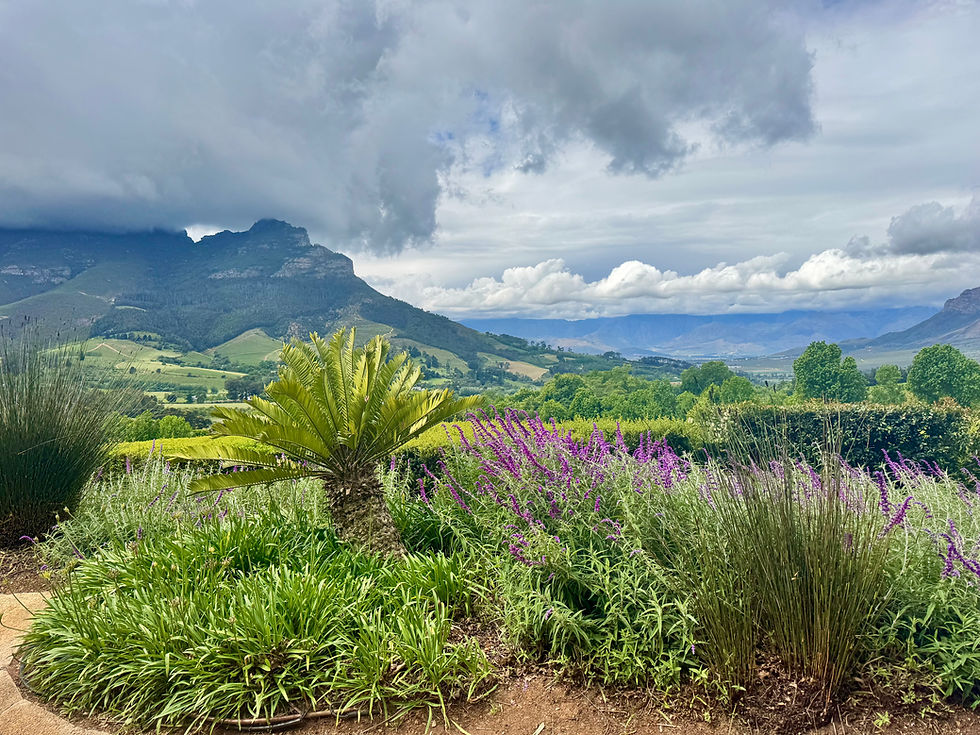
In Stellenbosch, I went to Helshoogte, which is a premier wine route with plenty of wine estates set in the most picturesque setting imaginable. My first stop was Tokara. A gorgeous peacock greeted me, showing off his feathers. But the restaurant was full and I was hungry. So I made my way to the simpler looking Le Pommier. Same view, same incredible wine, but much emptier. At Le Pommier, I had a wine-pizza tasting. The tiny pizzas were the perfect base for enjoying their Sauvignon variatals.
With wine tasting, you never have to worry if it’s going to be fun. Even when you’re alone! After the first flight I’m making friends with anyone who feels like chatting, ask lots of questions, or I type a blog post like this. Either way, I’m having a great time. I haven’t seen any spittoon anywhere. You’re both free and forced to drink it all.
My second stop was Delaire Graff. I worried it would be overly pretentious. The wine is the best, the views are the best, and the owner is a billionaire. But I found it to be a calm, leafy place with mostly regular costumers and friendly servers. I wasn’t blown away by the wines because honestly, after the first flight, which I always love, my palate kinda checks out. My palate isn’t particularly refined anyway—just extremely picky, which is not the same, I think. And when I’m in Stellenbosch at Delaire Graff, I’m definitely going to like that wine no matter what the grape variety or taste profile is.
The final stop was Zorgvliet, which is somehow related to Le Pommier. The atmosphere was colonial, not modern, but equally tasty and pretty. The whole experience felt different from France, where winemakers often identify as farmers and drink wine right alongside you. The sommelier here talked about the wine fondly, but he is not the owner of the place, or is he? I hesitate to ask, even though I’m curious. Apartheid, racial relations, the history of winemaking... I think everything is just a little bit more complicated in South Africa.
Johannesburg: Apartheid history
My last weekend in South Africa—I had a half marathon on the books, so Saturday morning was spoken for. Along with 15,000 other runners I completed a half marathon in the Jacaranda tree-lined streets of Rietondale. Afterwards, I’m a little sore from racing the hilly course but I can’t sit still, so I wander through the Botanical Garden later that afternoon. I wished I had my binoculars, though I don’t spot many interesting birds.
On Sunday, I took the Gauteng train to the Rosebank mall in Johannesburg, which takes about 40 minutes. At the top level of the mall, in a parking area, there is a massive antique and souvenir market. I recognized many crafts from other African countries, like baskets from Rwanda and mud cloths from Mali. It’s a good mixture of stuff, but I can’t shake the feeling that I already have everything I ever wanted or needed.
Next, I took a long taxi ride to Soweto. Seeing Soweto was the real reason I came to Johannesburg. It's where Nelson Mandela and Desmond Tutu lived and the center of political activism during that entire era. I booked a 4-hour bike tour with Lebo’s Backpackers. I’d found it online and later got two separate rave reviews from colleagues. Plus, you can’t really go wrong with a bike tour. If you love biking anyway!
The Uber ride from Rosebank to Soweto was revealing. We passed the beautiful World Cup stadium, where later the G20 was held, and where clearly another event was going on today. We also passed old gold mining sites. The rocky remains forming unnatural, bald hills along the highway. When we reached Soweto, it became clear that even though apartheid ended 32 years ago, physically the segregation and different (lower) living standards are still here. It’s not that there is anything “wrong” with these neighborhoods. It’s just like you entered an entirely different country. I asked the driver if any white people live here and he said no. Immigrants maybe? Yes. He said all the little supermarkets are owned by Pakistanis. When I asked why, he said that’s just what they do. I suppose you could say the same about Indians in The Gambia.
I was the only person who signed up for the afternoon bike tour that day. There were twenty people for the tuk-tuk tour, which I started to suspect was the smarter choice because it was hot. On the bright side, it gave me an opportunity to get to know the tour guide on a more personal level, and we even visited his house for some cold water (his mother didn’t appreciate the extra dishes, so I washed my own cup).
During the tour we naturally visited Vilakazi Street, which was home to Nelson Mandela and Desmond Tutu. The history there is heavy, especially the memorial site where children protested the low quality of education during the apartheid era and some were shot and killed in the streets. But it was a Sunday, which meant most people had the day off, and the atmosphere was festive. It seemed we were greeted from every shop, porch, and street corner.
There was a lot of public drinking going on. We got off of our bikes and walked a few streets, and I couldn’t help feeling uncomfortable by the many men who wanted to talk to me and touch me, clearly inebriated. I knew I wasn’t in any danger, but felt like we were attracting way too much unwanted attention. The tour guide seemed oblivious to this, treating each and every person as if they were a close friend. He pointed out some nice-looking apartment buildings, which have been unoccupied since they were finished in 2010 due to political dysfunction. The site had been a soccer pitch previously, but was now fenced off. Even the intention of building it was questionable, he said, because it seemed to serve as a pretty facade of the dilapidated neighborhood behind it.